
Three Common Portfolios Explained

I’m currently on my way back from Greece, a country I surprisingly have never visited (we found off-season plane tickets to Athens for $500 from Austin!). It’s funny how aging has flipped the script for me: I want to travel more now, fully aware that the window for comfortably schlepping through airports and cobblestone streets won’t stay wide open forever.
Meanwhile, my husband Brian is instead becoming more of a homebody. (This may have something to do with the fact that I refuse to pay for seat selection, which means we’re inevitably wedged into the middle non-reclining seats in the very back row, next to the bathrooms.) Once the kids are grown and we’re no longer buying four plane tickets everywhere, I fully plan to spring for lie-flat first-class seats at least once in the hopes of reigniting Brian’s love of travel! 🤣
Since the markets have been so turbulent lately, I thought it would be a good idea to revisit three common portfolio set-ups. We had a great discussion about these (and how they relate to the current 2026 market environment) at our Wealth Wednesday session a couple of weeks ago – you can view the recording here to watch that deep dive.
Note: This is general financial education, not individualized investment advice. Please do your own research before making portfolio decisions.
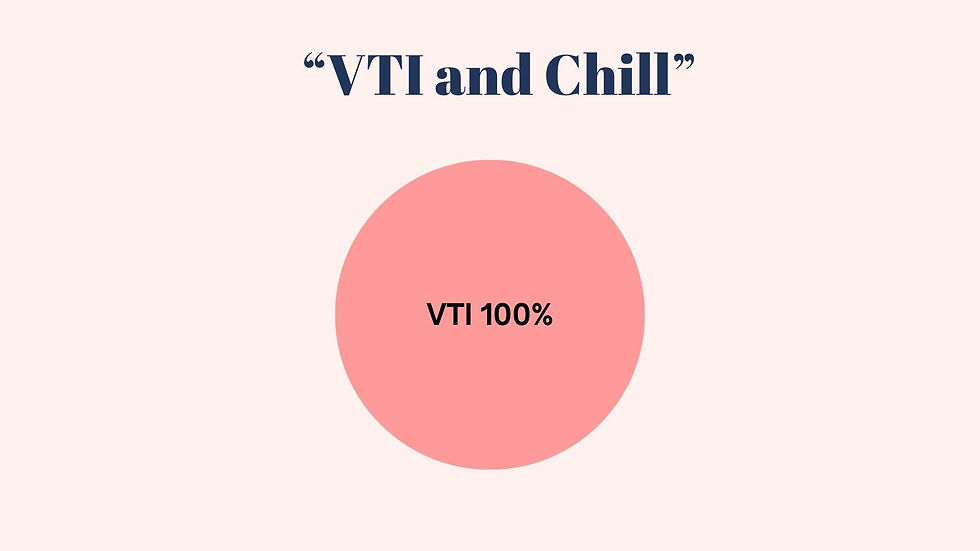
Portfolio Example #1: “VTI and Chill”
This approach was popularized by Jack Bogle and the Bogleheads and is still a perfectly reasonable choice for many investors. The idea is simple: invest the entire portfolio in VTI, Vanguard’s U.S. Total Stock Market Index ETF, and let time do the heavy lifting.
Pros:
Broad U.S. diversification with exposure to virtually every publicly traded U.S. company
Extremely low fees (0.03%)
Truly hands-off and very low maintenance
Cons:
Can be too aggressive for investors needing near-term access to their money (i.e. retirees)
Low international and bond exposure
Will not make you interesting at parties
Portfolio Example #2: “3-Fund Portfolio”
Another Boglehead favorite, the 3-fund portfolio adds international stocks and bonds to reduce reliance on the U.S. stock market alone. The exact mix can (and should) be adjusted based on your time horizon and risk tolerance.

Pros:
Good diversification across U.S., international, and bonds
Low fees
Low maintenance (may need occasional rebalancing)
Cons:
Will almost always underperform the market (a trade off for lower risk)
Also will not make you interesting at parties
Portfolio Example #3: “Risk Parity”
Popularized by Ray Dalio in the 1990s, risk parity portfolios aim to balance risk rather than dollars. They do this by combining assets that tend to move differently from one another, with the goal of performing reasonably well across all economic “seasons”: growth, recession, inflation, and deflation.

Pros:
Reduced risk concentration – good for investors with a low risk tolerance
May allow for higher withdrawal rate than the typical 4%
Useful for retirees who need a more stable portfolio
Useful for early retirees who need their money to last >30 years
Cons:
Will almost always underperform the market
Not a good option for growth or accumulation
Heavily reliant on backtesting, which can’t account for future market conditions
Typically includes a decent amount of gold and other commodities, which do not produce income
There’s no single “right” portfolio, just the right one for you. Your time horizon, your risk tolerance, and your real-life goals matter far more than whatever allocation is trending on the internet this year. Investing is a lot like travel: some people are fine white-knuckling it in economy for the long haul, while others want stability, legroom, and fewer surprises. The key is to set up a portfolio allocation that supports how YOU want to travel through this season of life. ✈️
Want to become more confident with investing? Check out our on-demand Wealth by Design program!


Comments