
Would You Still Work If 95% Went to Taxes?

If the government took 95% of your wages for income taxes, would you still go to work? What about 70%? Or 50%?
(Surprisingly, rates north of 50% actually can happen to self-employed U.S. residents in places with high state/local taxes!)
Since tax day was yesterday, I thought it would be interesting (fun?!) to take a deeper dive into the psychology behind paying taxes.
I recently was invited to speak at an event for the Black Women in Real Estate group here in Austin, and for the first time in any of my presentations the discussion veered into the Laffer Curve, which was extremely exciting for me as a tax nerd. 🤓
Originally popularized by Arthur Laffer, the Laffer Curve essentially attempts to predict the top tax rate that payers will tolerate before they won’t participate anymore (either by not working, not buying goods, moving away from that municipality, etc.). In most communities, that top tax rate tends to range between 50-80%.
Back in 2011, economists Mathias Trabandt and Harald Uhlig revisited the Laffer Curve for U.S. income, and found that the maximum tolerable rate was around 70%. Here’s what that curve looked like:
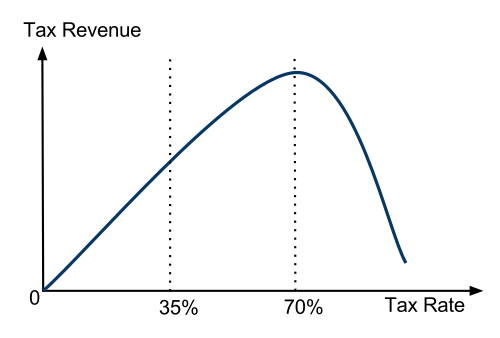
Policymakers actually use concepts like this to try to optimize tax revenue, because at a certain point, raising rates further doesn’t increase revenue - it decreases it. (After all, if 95% of your income went to taxes, would you still bother working??!)
It’s an interesting thought experiment to think about where your own tolerance is.
And this can even apply to things like property taxes; now that our property tax bill here in Austin is over $20k annually, we are strongly debating whether it’s worth staying in the city anymore. And it seems like we’re not the only ones! Last fall, the City of Austin held a vote (Proposition Q) on raising property taxes and additional 20%, and the Austin residents (who will generally throw money at any cause to better our community, me included) resoundingly voted it down. (This came as a huge shock to the City Council.)
But this indicates that people are getting squeezed, and the city is hitting that peak of the Laffer Curve, at least for now.
Aside from the Laffer Curve, there is also a growing subset of people who are refusing to pay their Federal Tax bills as an act of civil disobedience. They disagree with how that money is being spent by the current administration, so they are still filing returns (to avoid the failure-to-file penalty) but withholding their payment (with penalties and interest) until the money is being used for causes they support. (Not tax or legal advice!!)
Prominent lawyer Rachel Cohen wrote more about her reasoning behind taking this route here, if you’re interested in checking out her arguments.
Honestly, usually the most rebellious financial move isn’t refusing to pay taxes, but rather learning how to legally minimize them and build wealth anyway. Then the top tax rates matter less and you’re not contributing nearly as much towards things you may not support.
Enjoyed this post? Subscribe to our free weekly newsletter! 📩


Comments